A few days ago, my cousin shared photos of my 1 ½ year old niece’s outing to the Hyderabad Zoo (Nehru Park). This brought back pleasant memories of the numerous times in my childhood when our whole family used to visit the Alipore Zoo in Kolkata. Times and circumstances change, but memories and experiences such as these never fade. A trip to the zoo is a must-do for toddlers, pre-tweens and tweens.
Childhood Memories – Picnic!
As a child, every year, my parents and I, along with my entire extended family – uncles, aunts, cousins – used to visit the zoo either on the New Year or Christmas Day, without fail. Despite going there so many times we, my cousins & I, never got tired of the annual trip. In fact, we really looked forward to it.
We used to carry homecooked food, plates, cutlery, blankets, and playing items like badminton racquets, shuttle corks, flying discs – a veritable picnic! Waking up early, packing all the stuff, getting dressed – everything was part of the fun. On reaching, spreading out the blanket under a shady tree and unloading our goodies – it was all so exciting. Then came the best part – actually going around the zoo and watching the animals!
Alipore Zoological Garden - Then
The Alipore Zoological Garden or, as we called it, the Alipore Zoo was filled with animals of abundant species, animals of all shapes and sizes. There were tigers, lions, leopards, hyenas, jackals on the one hand, and hippos, rhinos, and elephants on the other. Then there were giraffes, deer, zebras, chimps along with birds and reptiles!
The tigers were within an open enclosure with a cave to go into. We used to wait for them to come out and roam so we could catch a glimpse. The hippos too were in their own water enclosure where they had a gala time splashing around – or so it seemed to me at that age. The elephants were chained in an open space unfortunately, but we used to watch them being bathed and fed by their mahouts.
I used to love the special reptile house – it seemed to be dark and mysterious to me. Various species of crocodiles, snakes etc. were housed there. This is ironic because I’m deadly afraid of reptiles now.
There were oodles of park space with huge trees to provide shade as well as open space to play stuff like badminton etc. It was a nurturing environment.
The Zoo & Animals - Today
Today, the zoo has been revamped and smartened up. What some used to consider crusty old enclosure, park space, buildings etc. have been upgraded. There’s a lake and a restaurant. Many new species of animals have been brought in; there is now an aquarium, an aviary, better and more enclosures to create natural habitats for the animals. The basic structure of the zoo has remained the same but it’s an upgraded experience now which I’m sure children will love.
Inaugurated in 1875, the zoo today covers 46.5 acres of land and is home to over 1200 animals spread over 108 species. It draws 3 million visitors annually. (Source: Wikipedia)
The Zoo has undertaken various programs for the conservation of animals and for their general well-being and maintenance. 5 ways in which the Alipore Zoological Garden is helping in maintaining the animal ecosystem:
Animal Adoption – Individuals or institutions can “adopt” certain animals. The money paid for the adoption goes towards care of the animals. This develops a love of animals among the people.
Zoo Education – Various events are organized to create awareness among humans and to educate them on the need for preservation of nature’s beings.
Research – There are research conducted on animal behavior to help understand them and thus take care of them in a better manner.
Conservation Breeding – This is done to conserve a particular breed or species and to prevent them from dying out.
Rescue & Rehabilitation – To take in injured animals and help set up a home for them to recuperate.
What We Can Do
In our turn, we can take some steps to help the environment:
Keep the zoo gardens and park clean – Pick up rubbish after you have had your picnic and throw them in designated bins.
Do not disturb the animals – Let us not play loud music, tease & catcall at them or try to feed them. Let them be in their home in peace.
Let’s not use plastic – Help preserve the environment that is home to these animals by being environment friendly.
I am doing my bit by raising awareness through this post via Blogchatter’s Cause A Chatter campaign.
Fun & Learning for Kids
Not only is a visit to the zoo a fun outing for kids, it is also a learning experience – to educate them on various living beings, recognizing different animals and to be aware of the environment. I think it is a must visit for every child.
Details To Know For A Visit
Timings: The Zoo is open on all days except Thursdays. During the Xmas holidays, it is open on all days. Operating hours are 9 AM – 5 PM.
Ticket Prices: Rs. 5 for kids upto 5 years and Rs. 30 for others.
Location: 2 No. Alipore Road, Kolkata 700 027, West Bengal, India
Lockdown and work from home has provided a small silver lining. After ages, I have been able to stay in my hometown Kolkata for more than a few days. For the last several years it has always been a flying visit but this time, due to the facility of working from home, its a longer visit. Taking advantage of that, I have been around the city and reacquainting myself with its beauty.
They are just phone snaps, taken from a moving car at most times but my city enchanted me all over again and I would like to share the beauty of my hometown with everyone. Presenting, the City of Joy, Kolkata!
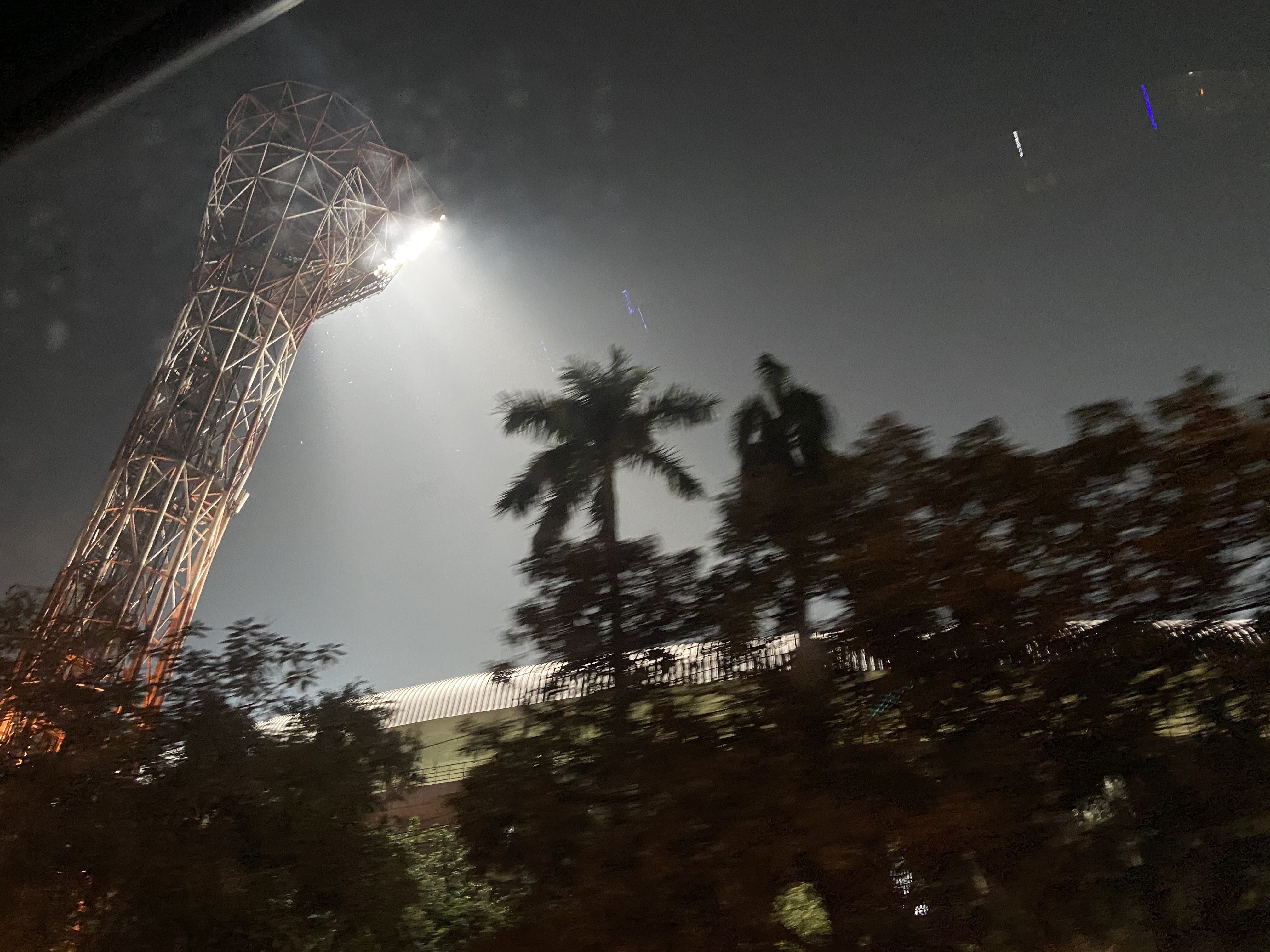
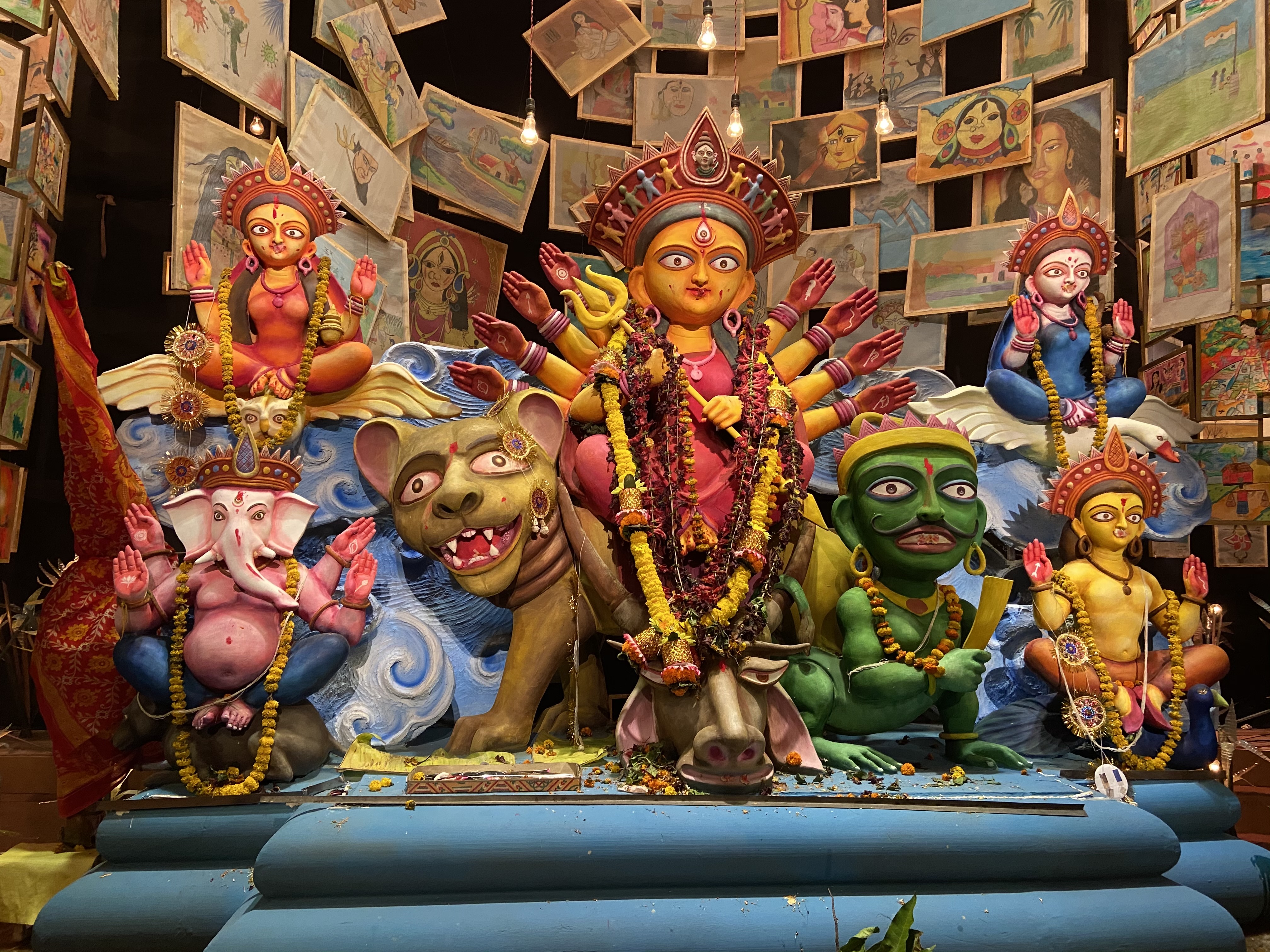
Red RoadPrinsep Ghat and Vidyasagar Setu in the backdropFloodlights of Eden GardenEden Gardens outside facadeVictoria on the move…Rabindra SadanRandom city road click2nd Hoogly Bridge or Vidyasagar SetuGreenery @ Prinsep GhatVictoria Memorial (from the car)Durga idol at the festivalRandom road click 2 – and because we rarely see so much greenery in MumbaiKali idol at Kali Pujo (in bengal) festivalA local game of football in progress
Victoria Memorial
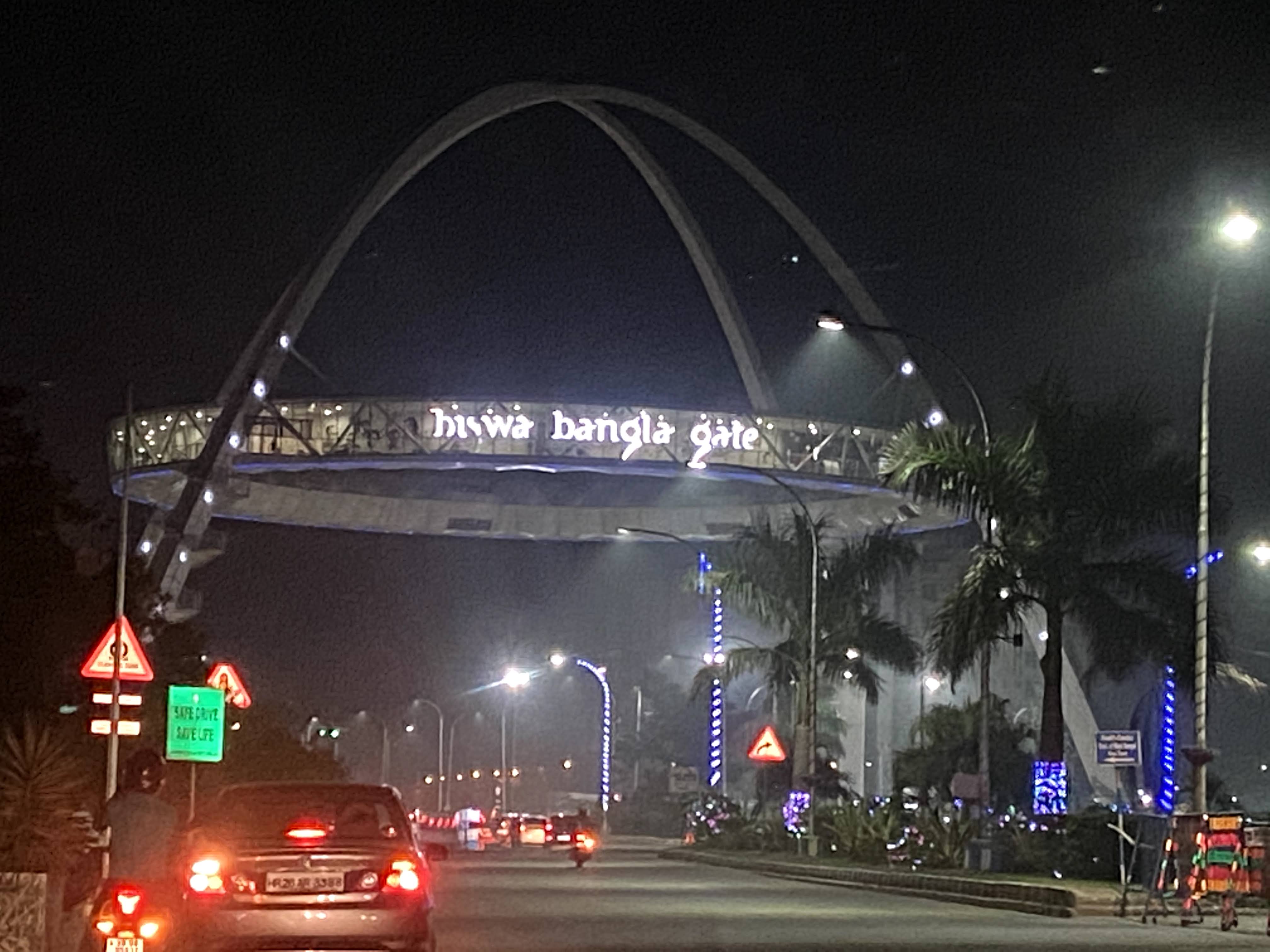
Diwali Lights!Biswa Bangla Gate
I will keep adding to this post as and when I explore more. Its been wonderful getting to know my city all over again!
There are a few experiences we all wish to have some day. Call it the Bucket List if you will. One such wish of mine was to be in the midst of live snowfall. I hail from Kolkata in India and the coldest we get there is 10 deg. C. Snowfall was like a fantasy to me. My first experience with snowfall was in Auli, Himachal Pradesh. But that did not lessen the wonder and joy I felt when it started to snow on the way to Sandakphu from Tumling.
I visited Tumling with my family during the 1st week of January this year. It was a 2-day visit but it was an experience of a lifetime! It is such a quaint and picturesque village that I felt like simply roaming the streets and just staring in wonder at the beauty that surrounded me. Tumling has a rustic charm that beckoned me and got me hooked.
Tumling in panorama
Day 1
Maneybhanjyang-Land Rover-Tumling
We traveled to Tumling in a hired car (pre-booked) from Darjeeling. The car took us only upto Manebhanjyang, a pit stop for every traveler. It takes about 1.5 hrs to reach there – a distance of 26 kms. The drive is a pleasant one, with cold winds and amazing views of the Himalayas.
Tip: The fare from Darjeeling is in the range of Rs. 1500-2000 but do negotiate on this, especially if it is off-season.
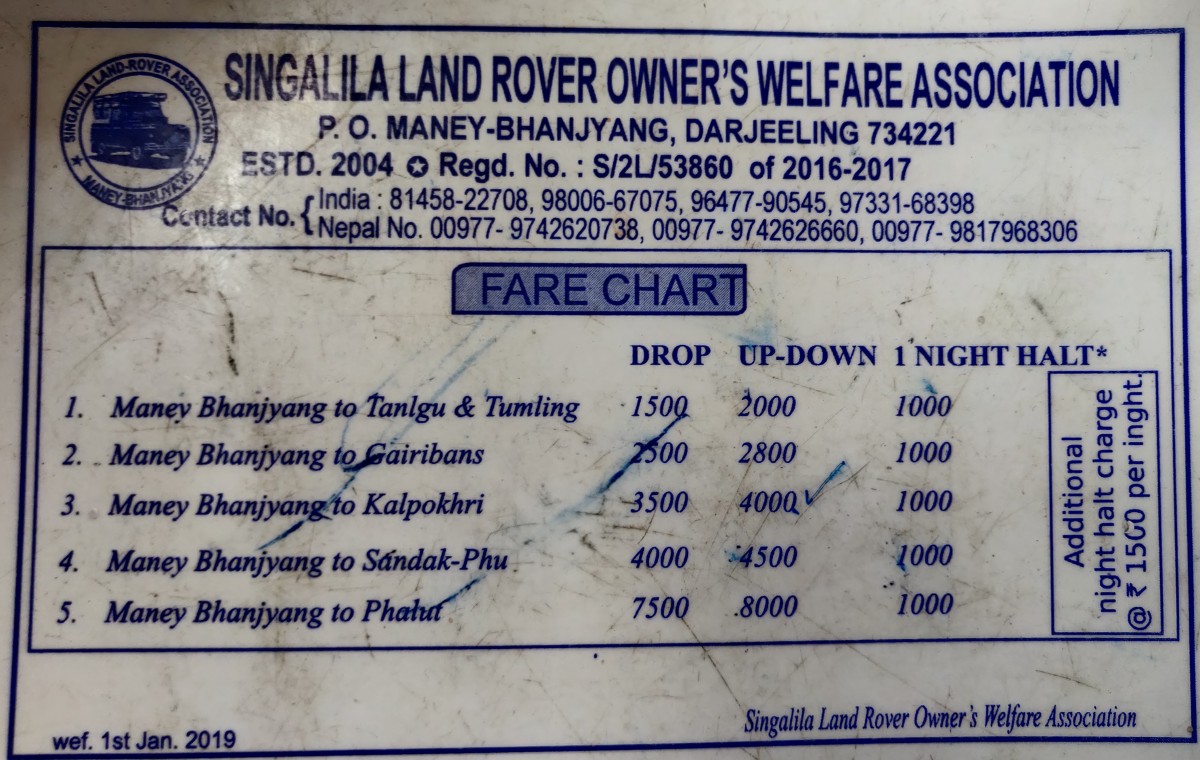
Beyond Maneybhanjyang, conveyance is all under the control of the Land Rover Owners Welfare Association. There is no option other than hiring a car from the association. The rates for the cars are fixed based on your end destination, whether it is a round trip and whether or not you want the car to stay “overnight”. There are 2 types of cars available – an actual Land Rover or a Bolero (4-wheel drive); allocation is based on your destination (Tonglu/Tumling or Sandakphu).
Tip: Overnight means, the same car will be back the next morning to pick you up; the car doesn’t actually stay overnight. So be sure to let your driver know of your early morning plans if any. (In case your end destination is Sandakphu, then the car will stay over.)
Car rate card for Singalila National Park destinations
We hired a car for Sandakphu. This was actually a spur of the moment decision, one we were both thankful and regretful for the next day. I’ll explain why further on.
Tumling
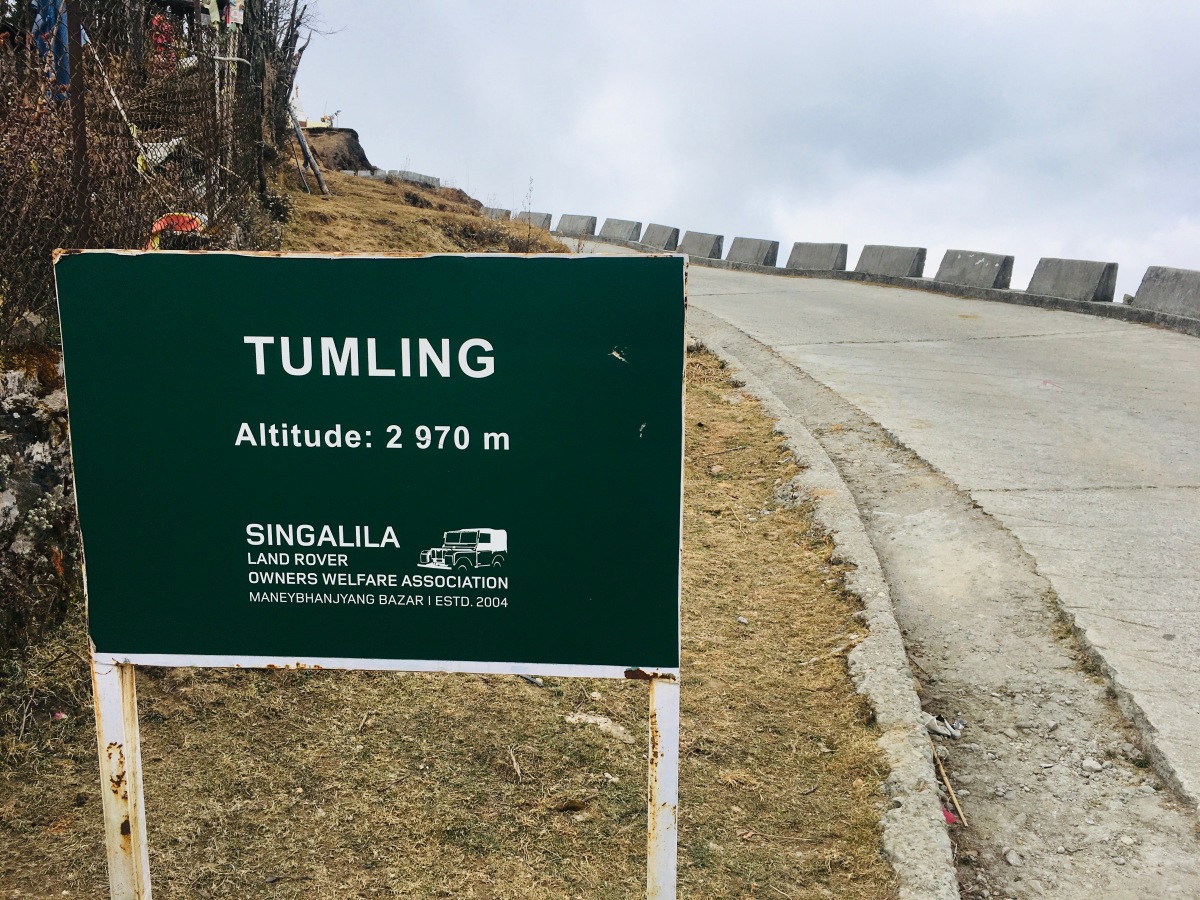
Tumling is a tiny village located on the border between India and Nepal at an altitude of 2970 m (~9750 ft). It is an open border and you never even realize when you cross over to another country altogether. There is a stone pillar-ish outcrop that says “BHARAT” meaning, India. So the road to the village belongs to India but the actual village is in fact in Nepal.
It is a part of the Singalila National Park. To enter the national park, we were charged a fee of Rs. 100 per person and per car, per day. Singalila hosts a wide variety of flora and fauna, the most noted of which is the Red Panda. We, however, did not have the fortune to encounter one.
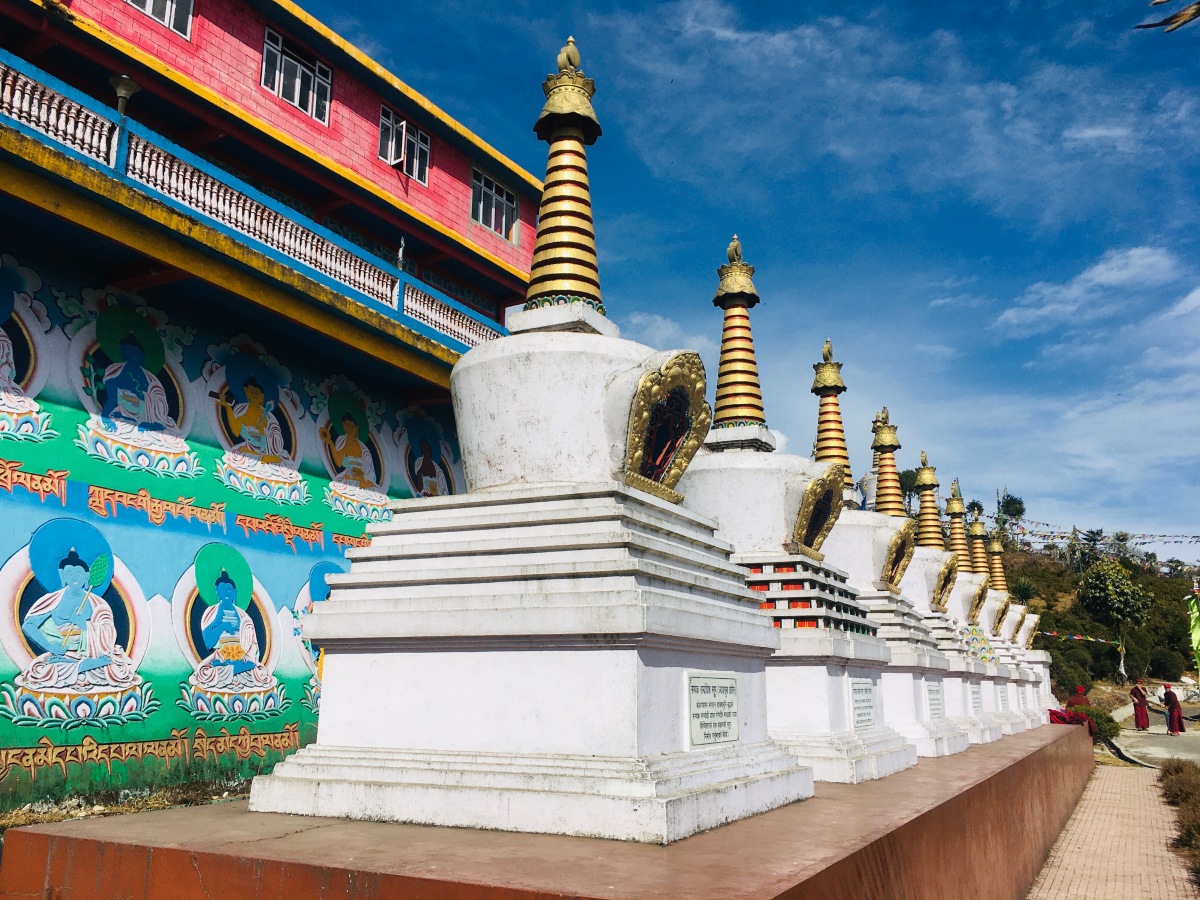
On the way to Tumling, we stopped at the village of Meghma to visit a famous monastery around 70 yrs old. Sadly the monastery itself was closed for prayer. But OMG the views from there are stunning and worth a visit for that reason itself! And there’s a cute little shaded bench on the edge on the mountain, where you can sit for eons and enjoy the view.
View from Meghma
Stupas @ Meghma Monastery
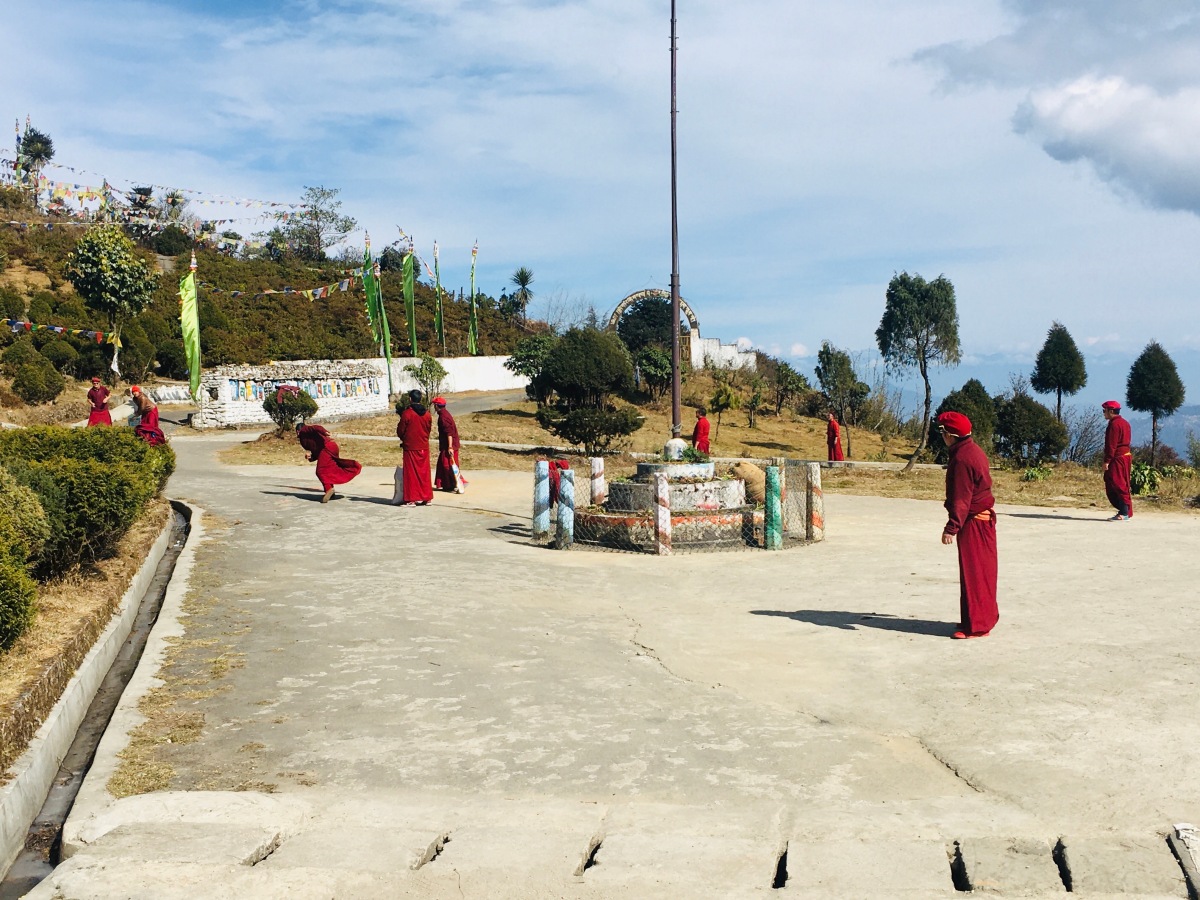
Monks enjoying a game of cricket
Reaching Tumling at about noon – 1 hour 15 minutes from Manyebhanjan – we were met with freezing weather and biting cold winds. But the village itself looked like a picture postcard! The car bumped along broken roads to drop us at our hotel – Shikhar Lodge.
Tip: Shikhar Lodge is a picturesque lodge with great services. Other lodges in Tumling are – Siddhartha Lodge, Satkar Lodge and Mountain Lodge.
The village of Tumling
Dumping our luggage, we took a walk about the area. The cold was enervating and we embraced it. We took some snaps against our cute little lodge, of the fabulous views of the hills and of us smothered under layers! Lunch consisted of simple homemade food – rice, daal, sabji and egg curry. The smoking hot, delicious meal was the perfect antidote to such cold weather.
Post lunch, we took off to explore this picturesque village. Tumling has only about 10-15 houses altogether, including lodges and teensy shops. Time slid away as we walked along the village road with a breathtaking mountain panorama spread out in front of us. We walked up the road leading to Sandakphu, upto a small temple at the crest of that road, where prayer flags fluttered wildly in the breeze. It was an enjoyable walk and the view coupled with the cold was wonderfully refreshing.
Prayer flags – Tumling
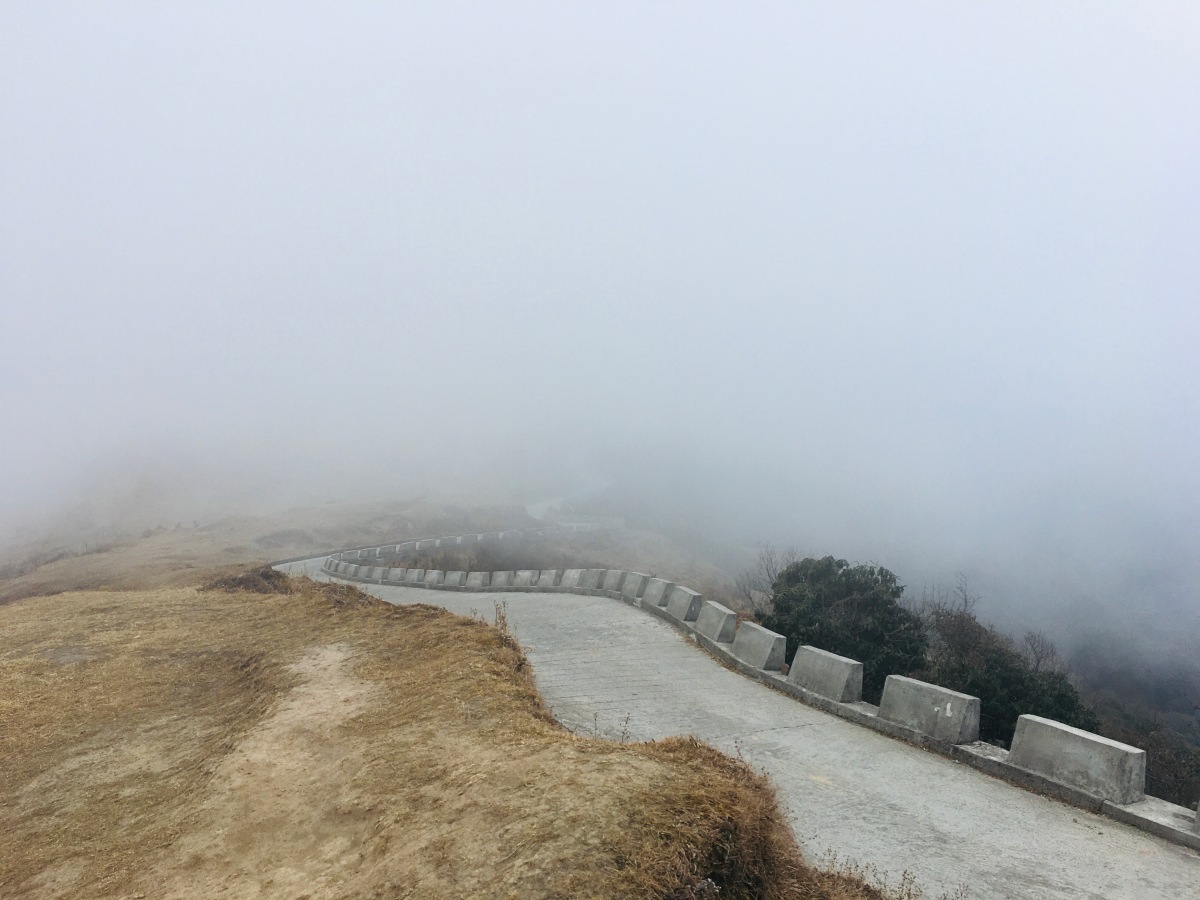
Road to Tumling
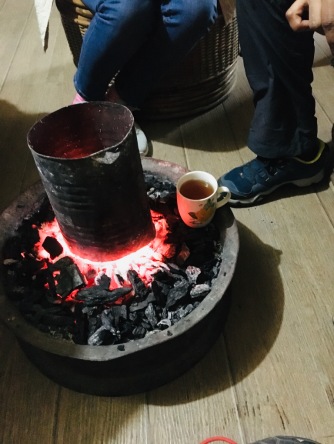
Evening was colder still so the lodge guys lit a fire for us creating a warm cozy atmosphere. Hot tea and pakodas while roasting our hands in front of the fire! That was a memorable evening and exactly what you’d imagine when visiting such places.
Tip: Wear layers – thermals, jackets, sweaters – as well caps, gloves and socks. Cover your nose as that keeps the warmth within.
Tip: Lodges are basic so be prepared. It would be better to have meals at the lodge itself since there aren’t any restaurants around, only one small snacks shop making momos and the like.
Day 2
Sunrise that wasn’t-unreachable Sandakphu-Snowfall!!
We woke up at 5 am and layered up to go out and watch the sunrise. Breaths freezing in our lungs – ZERO degrees!! – we climbed the mountain. Alas! It was a cloudy day and we couldn’t see a thing. On a clear day, the sun-rays sparkling on the Kanchenjunga would have made for a stupendous view – a golden Sleeping Buddha!
Tip: Be sure to catch the sunset in the evening.
Nepalese bread – sweet but yummy!
Sandakphu
View from Sandakphu. Pic credit: Wikipedia
Sandakphu is the highest peak in West Bengal (India) and Mechi (Nepal). It is known for its magnificent views of four of the world’s highest peaks – Mt. Everest, Mt. Kanchenjunga, Mt. Makalu and Mt. Lhotse. Sandakphu-Phalut is a popular trekking destination – the route beginning in Maneybhanjan and going through Tumling. Nowhere else in the world will you have this privilege of looking at the highest peaks of the world at the same time!
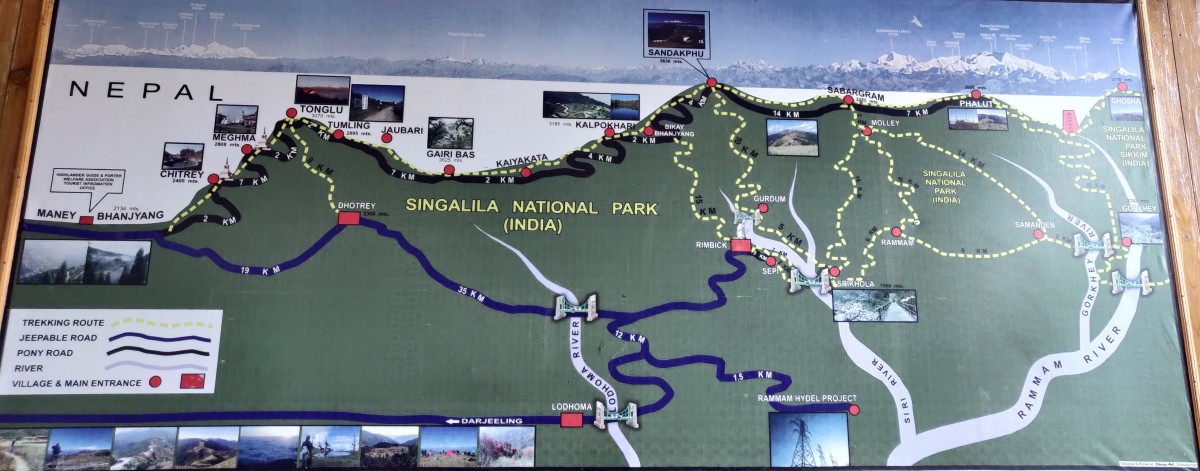
Sandak-Phu routes and distances
It was a cloudy day and there were forecasts of bad weather as the day wore on. Our car arrived late and we had to make a decision whether to abort our Sandakphu plan or not. Ultimately, we decided to take the risk – we would go until the point where it was feasible and then get back.
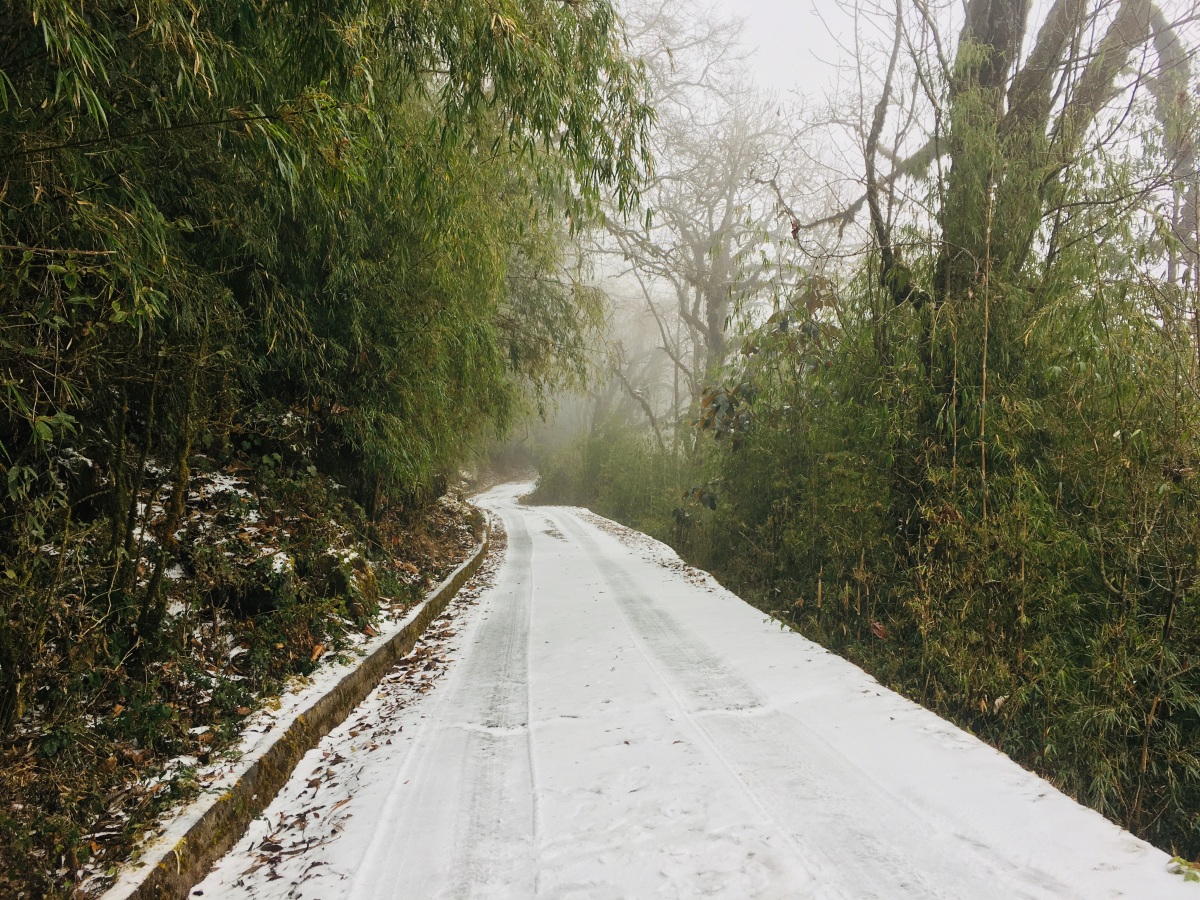
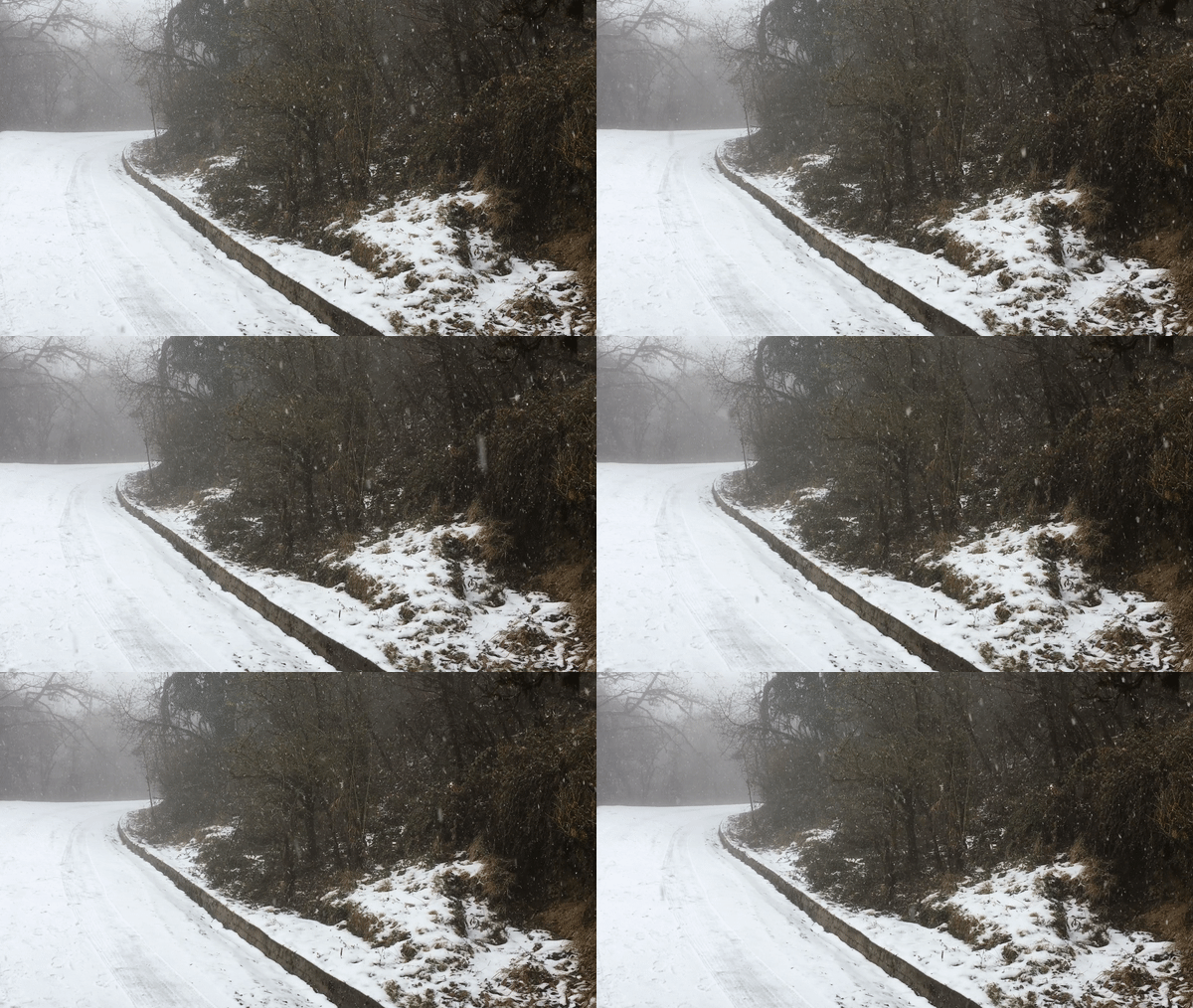
This journey offered us a different type of scenery – towering oaks and rhododendrons creating an arched pathway for us. This drive was one of the most scenic I have ever experienced. And then, partway into the ride, it started to snow.
On the way to Sandakphu
Wow!! We started in wonder at the snow as it rapidly carpeted the road. We stuck out our hands and tried to catch the snow (so childish I know!). Stopping at some random place, we got off to take some photos. But it was so cold, so cold that we got back into the warmth of the car pretty quickly. Crossing Jaubari, Gairibas and Kayakatta, we reached Kalapokhri, a mere 5 kms away from Sandakphu.
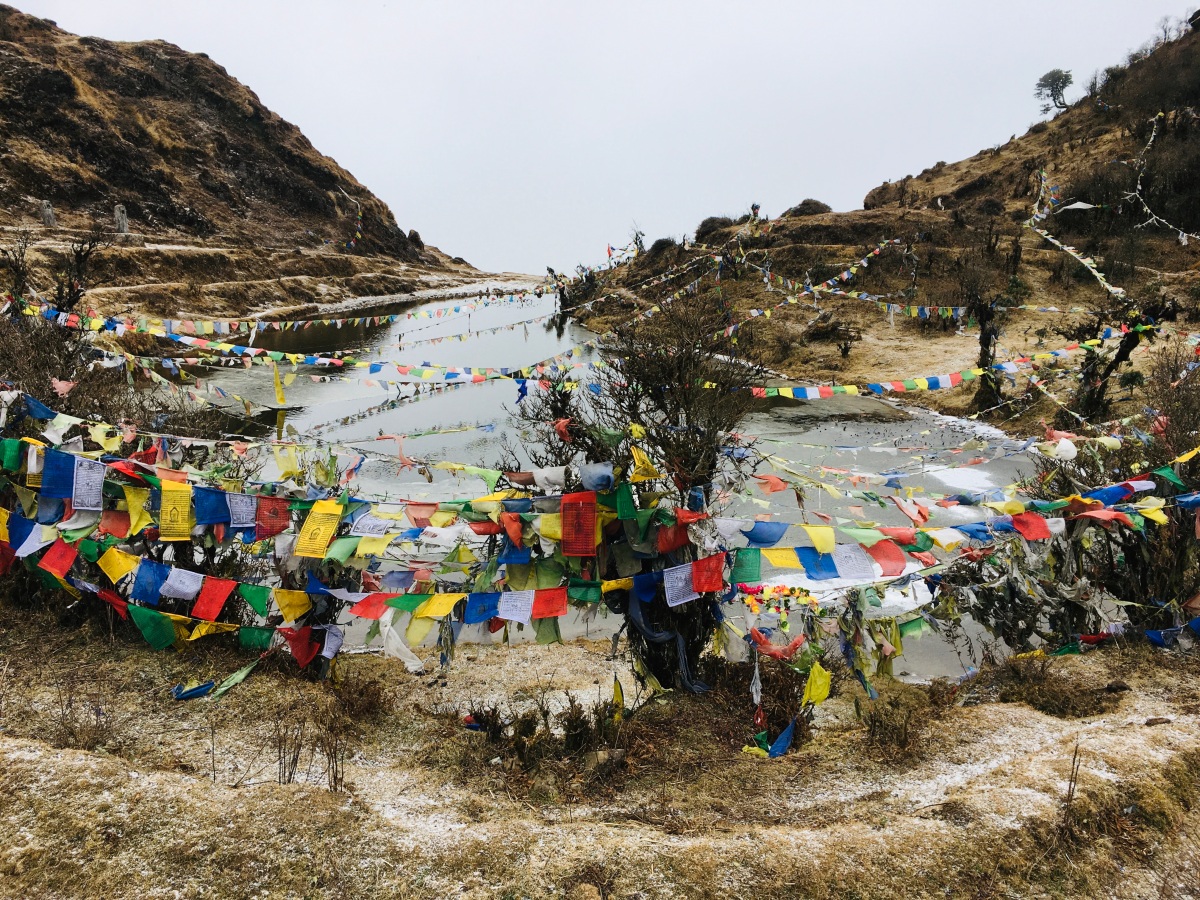
Kalapokhri was beautiful; it has a small holy lake and a cute temple residing among the mountains. It was beyond FREEZING by the time we reached there and snowing heavily. My hands were numb and my fingers barely moved as I tried taking photos. Standing in the midst of the buffeting wind and snow though, that feeling was unparalleled.
Kalapokhri
We spent about 15 minutes there after which the cold forced us to retreat into the car. Going further was pointless and risky so we decided to turn back from Kalapokhri. The journey back was fraught with tension. We were held up for a long time, since other cars were stuck in the 4-inch deep snow. Eventually we reached Tumling, picked up our luggage and drove back to Maneybhanjyang, and further onto Siliguri for our return to Mumbai the next day.
We regretted not being able to see the view from Sandakphu but boy were we thankful we got to experience the snow! It was a superb adventure!
Tip: The drive to Sandakphu is about 2.5 hours from Tumling and about 1.5 hours to return. Maneybhanjyang to Sandakphu return trip is about 6-7 hours. So, plan your trip accordingly. You can even stay at Sandakphu itself, it has homestays.
If you are looking for a vacation to a place off the beaten path, look no further than this charming village straddling the border. It is THE idyllic vacation which will relax and freshen your mind.
Year-end trips are a way of refreshing the mind and recharging our batteries for the year ahead. I bid adieu to 2019 and welcomed 2020 in the lap of nature – Darjeeling and the tiny border village of Tumling.
There is a multitude of information on the internet on what to do when in Darjeeling. What I am trying to do here is to share my experience, which entails how to make the best of your short holiday. I went online, asked friends and acquaintances to gather information. Based on this extensive research I planned my itinerary – 3 days in Darjeeling and a short side trip to an offbeat place nearby.
We i.e. my family and myself flew from Kolkata to Bagdogra airport in Siliguri – a short flight of 1 hr. – from where we took a pre-booked cab to reach Darjeeling.
Tip: The other way to reach Siliguri is via train upto NJP (New Jalpaiguri) Station.
Tip: You can easily hire a car outside the airport – there will be no shortage. But please do haggle on the fares because they may quote high prices. Bagdogra/NJP to Darjeeling should cost around Rs. 3500 by car. Make sure to reach Bagdogra or NJP before noon, so that you can reach your end destination within evening. It is advisable to not drive after dark.
It’s said, “It’s the journey that matters, not the destination”. As we traveled over the scenic mountain roads, this certainly was the case. Lush green tea gardens, towering pine trees and snow-capped mountains in the distance – eventually drawing close as we drove from a mere 400 ft to an altitude of 6800 ft. I could feel the change in weather as well – from the hot sunny weather in Siliguri to the evening chill of 4° C in Darjeeling.
Tip: Be sure to be suitably attired for this weather with jackets, scarves, gloves and hats. Layer more as night falls with thermal-wear.
Day 1
Evening-tea-mall walk-Glenary’s
After checking in at our hotel we had a cup of refreshing evening tea – we Bengalis love our tea morning and evening! We then set off to explore. Walking to the Mall, we enjoyed the biting cold, our breaths freezing in the sharp evening air.
Tip: Gandhi Road is one of the best areas to stay in, because of its nearness to the Mall and Chowrasta; it’s also a walking distance from the Chauk Bazaar and Taxi Stand as well.
The Mall
The Mall is a burst of color and activity – shops selling winter clothes, tea, curios, paintings and what not. I felt like ducking into each of the shops to look at their offerings – there is so much to look at and take in! We did a little bit of window shopping and soaking in the lively atmosphere – this place has an attraction of its own.
Tip: Most shops on the Mall close by 8 PM in the evening (some e.g. Golden Tips, pop-up winter clothes stores, etc. do remain open till later). Make sure to do all your shopping – window or otherwise – by then. Restaurants mostly close by 10.30 PM, some even before that, so getting a seat is hard after 8:00 especially in peak season.
Glenary’s facade
Glenary’s
We capped off our first day with dinner at Glenary’s. Glenary’s is known for its bakery but the food here is delicious as well. Roast pork, fried chicken and mixed chowmein was utterly yummy. There is live music as well – it’s wonderful being serenaded while you eat! Do visit Glenary’s when you are in Darjeeling – it’s a must do!
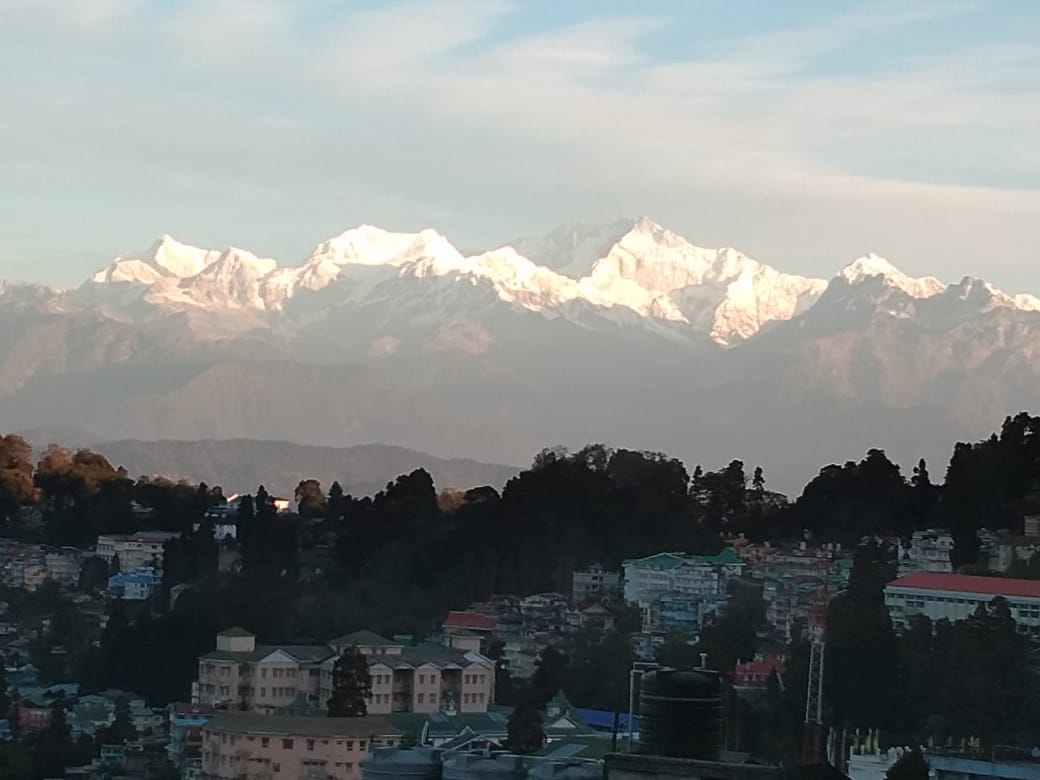
Next morning was a gift from the mountain gods. As I woke up and looked outside my window, I was greeted by the majestic Mt. Kanchenjunga in all its glory! What a breathtaking view it was! There stood the 3rd highest mountain in the world at such close quarters – sparkling white against the pristine blue sky. Wow – I stood there gazing at that wonder for eons. This was the highlight of my visit.
The day was planned for sightseeing points close-by. We booked a car via the hotel itself for a half- day tour to 4 points.
Tip: You can talk to your hotel; they will arrange a car for day tour of Darjeeling. It should cost around Rs. 3500 for 5 points trip.
Keventer’s
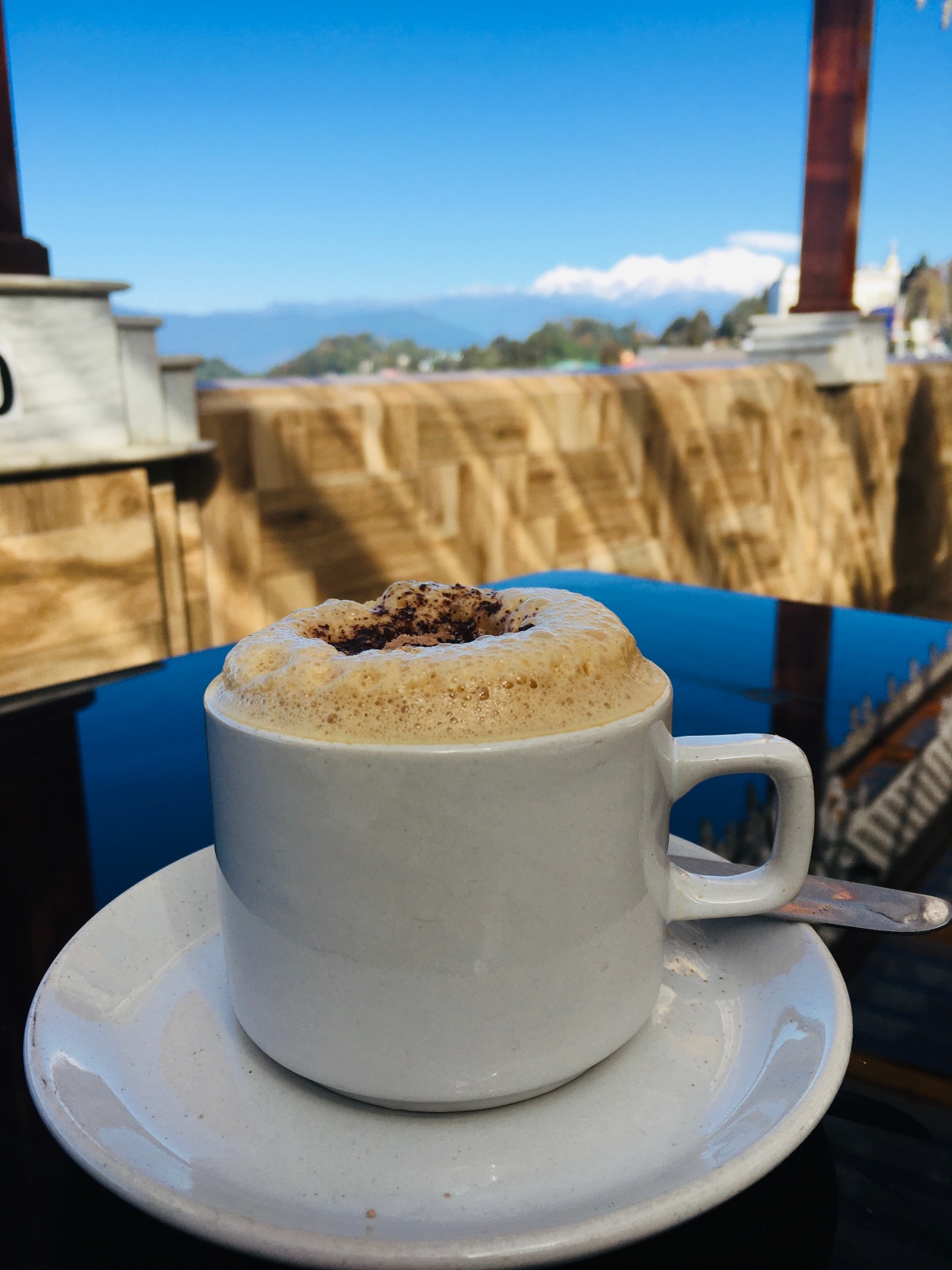
We breakfasted that day at the famous Keventer’s. Located at the entry point of the Mall, it’s known for its drool worthy breakfast and snacks. What I had was the pork platter – sausages, bacon, ham, salami and fried egg – and coffee. They were super yummy!
Tip: Platters are available in chicken as well. The hot chocolate is also worth a taste, my sister says.
Ghoom Monastery
Samten Choling, the new Ghoom Monastery (old one is called Yiga Choeling) is located on the Hill Cart Road, about 20 minutes away from Darjeeling. On reaching, one needs to climb down a number of steps to reach a large open space accommodating the monastery. The steps are not in good condition so mind your step! This white building with a golden top houses a huge idol of Lord Buddha at its centre. Spend a few minutes admiring the ancient paintings on the walls. The serene and quiet atmosphere had a calming effect on me.
Golden idol of Lord Buddha @Ghoom Monastery
Lamahatta
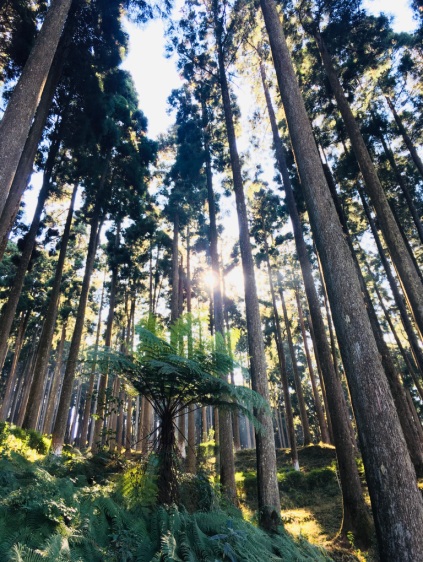
Lamahatta is about an hour’s drive (~25kms) from Darjeeling. The main attraction here is its eco-tourism – a picturesque eco-forest on the slopes of a mountain with an abundance of pine trees. Until a year ago, there were several short trekking routes to reach the mountain top, however now there is a 1 km pre-marked trekking route to the sacred pond. It is a pleasant trek with an amazing view though the pond is not really a big deal. The forest makes for some pretty pictures with its tall trees and the sun shining through the gaps. Walking on the cobbled path, I felt like an adventurer – climbing up in search of the pond.
Tribeni
Tribeni is the confluence of 2 rivers – Teesta and Rangit. This sightseeing point is basically a viewpoint of that confluence. It is a beautiful sight – the blue-green waters mixing into one another. The subtle shade difference – which arises due to different densities and content – makes for an alluring picture.
Tip: Optional activity is rafting on the Rangit river but in the month of December this is something we opted not to do.
Japanese Temple and Peace Pagoda
Last stop of the day was the Japanese Temple and the Peace Pagoda. They are situated in the same compound and is in Darjeeling itself. The temple is guarded by 2 white stone lion statues and the main temple is on the 1st floor. We were fortunate enough to take part in the evening prayer where we played a musical instrument as part of prayer; a racquet like thing to be struck with a wooden stick to the rhythm of their prayer song. It is soothing and so utterly peaceful. While leaving we were given “nakuldana” prasad. The temple houses golden statues of Lord Buddha.
Peace Pagoda
Peace Pagoda perches atop 40 odd steps a few metres away from the temple – a white stone structure with a huge golden statue of Lord Buddha. There are other statues depicting various avatars of Lord Buddha but unfortunately, I did not go up close because by then it was freezing cold and we were too tired to climb the stairs. Make sure you do visit the Pagoda from close quarters.
After the car dropped us back and we had had a little rest, we went shopping on the mall. Keychains, prayer flags, magnets, wind chimes, shawls, jewellery – we got some of each. You just cannot resist all the cute and colorful knick-knacks. That night, we cut a cake from Glenary’s to inaugurate the new year. Happy 2020!
Tip: Do haggle with the shopkeepers for these momentos and be sure to check all shops before buying.
Day 3
Toy train-Cable Car
Toy Train (DHR)
The DHR Toy Train!
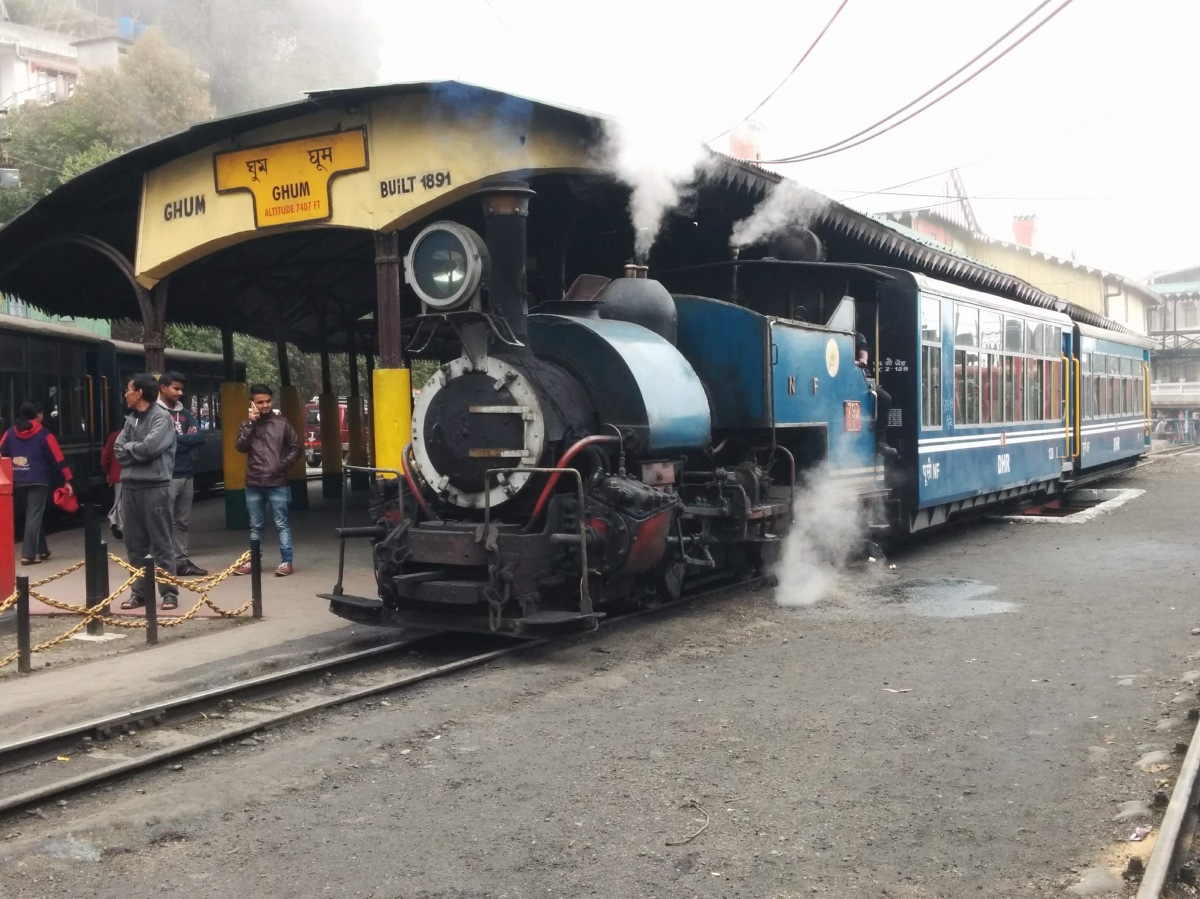
The 1st day of 2020 was a throwback to childhood and an ode to Bollywood. We rode the Toy Train from Darjeeling to Ghum and back! As a child, I used to love trains.
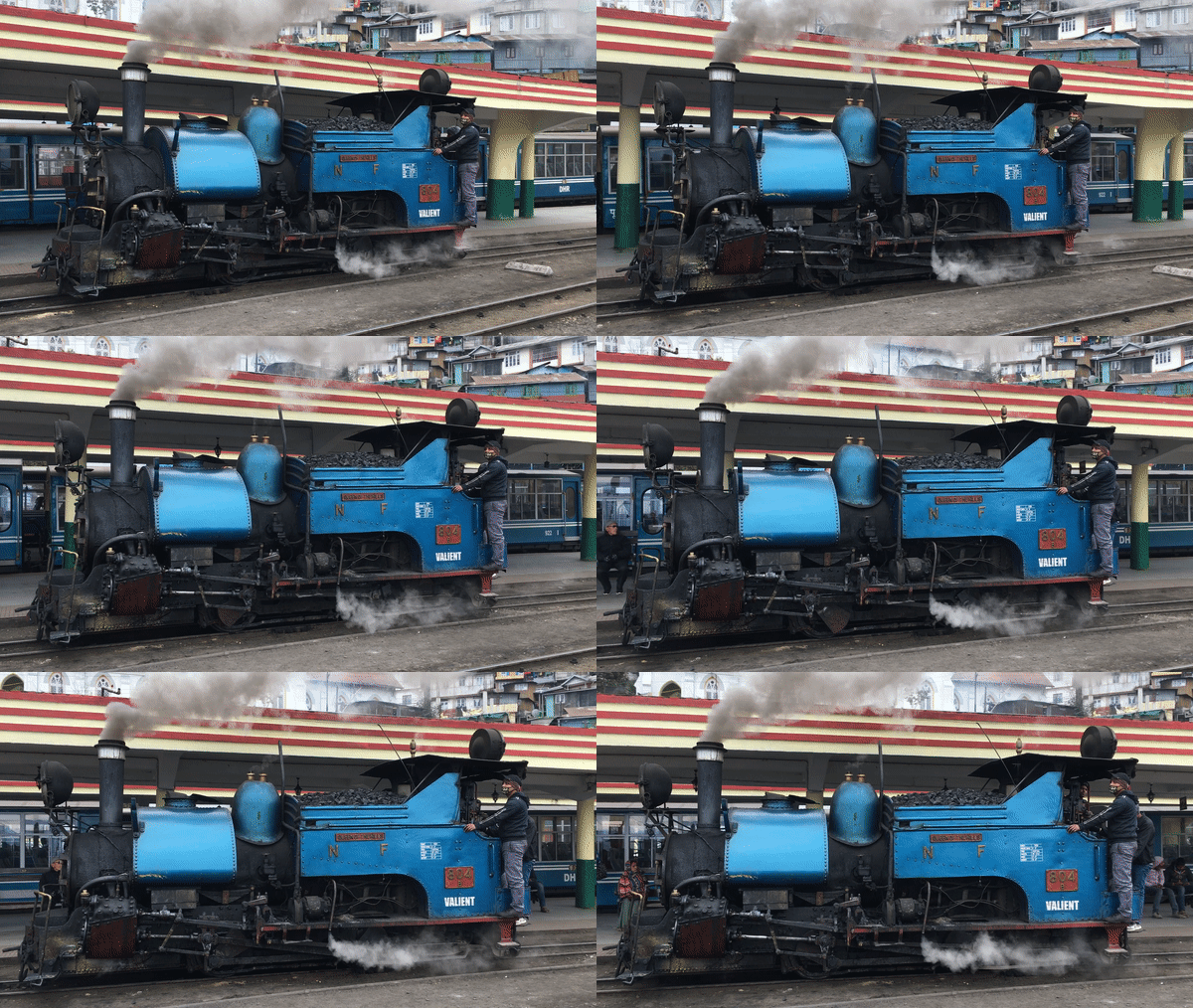
Originally used as a mode of transportation between New Jalpaiguri and Darjeeling districts, it is now run as only joyrides. It is called the Darjeeling Himalayan Railways (DHR), a UNESCO World heritage site. These are narrow gauge trains, which are either steam or diesel fueled. The DHR climbs from sea level to a height of 7407ft at Darjeeling via several loops, zigzags and Z-reverses to combat the terrain and gain altitude.
The most famous of the loops is the Batasia Loop which is now a sightseeing point and the 1st stop on the Darjeeling-Ghum-Darjeeling train. It includes a beautiful garden and a War Memorial. The view from the loop is scenic.
Tip: The train gives a 10 minute stop here but you can visit this place separately as part of your half-day sightseeing tour.
Batasia Loop
The next stop is Ghum station (7407 ft) for a duration of 30 minutes. You can get off here, explore Ghum, and then return on your own steam to Darjeeling or take this same train back (included in the fare). We used those 30 minutes to have a look through the small one-room Ghum Museum (free of cost), which has some very interesting information and pictures about the DHR and the way it works. I found this tiny museum utterly charming and the train trivia fascinated me.
Tip: The whole journey is 2 hours long and there are several trains per day.
Back to Darjeeling by noon, we spent the rest of the day just roaming around Darjeeling since we had already visited all the other places worth seeing on our last trip. The last thing we wanted to do in Darjeeling was ride the Darjeeling Ropeway. Unfortunately, we couldn’t due to lack of tickets. The Ropeway takes you from Singamari (~7000ft) to Singla Bazar (~800 ft) and has beautiful views of the Rangit river valley.
Tip: If you want to ride these cable cars, be sure to book your tickets in the morning itself because they tend to get sold out by evening. Also, there are long queues so be prepared for a significant wait.
Pic credit: Holidify
Tip: You can also visit the following places during your second day in Darjeeling. We had already been to these during our last trip few years ago.
The Padmaja Naidu Himalayan Zoological Park (Darjeeling Zoo) houses varied species of animals including Red Pandas, Tibetan Wolf and the Royal Bengal Tiger.
Royal Bengal Tiger @ Darjeeling Zoo
The Himalayan Mountaineering Institute has a museum which has memorabilia belonging to Tenzing Norgay, the Sherpa who was one of the first 2 people to climb Mt. Everest. It has other artifacts and information pertaining to mountains and mountaineering. These two are worth a visit. They are entered via the same gate and has a common entrance fee.
Tea Estate
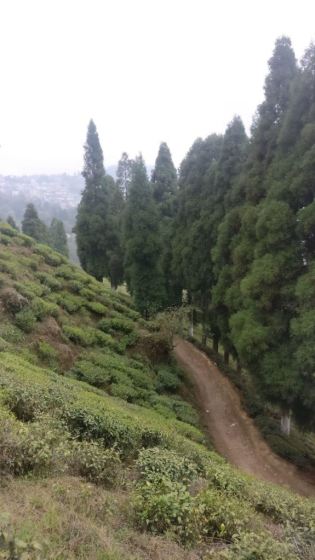
Happy Valley Tea Estate contains rolling tea gardens over the hilly slopes of Darjeeling. They have a tour of their tea-picking, processing and manufacturing stages in their estate, which ends with a tea tasting. We came away from our visit to this pretty tea estate with newfound knowledge on the various types of tea, which is the best and how to recognize good tea. This is a must do while in Darjeeling!
The most known sightseeing place which most people go to is the Tiger Hill – to watch the sunrise. But from what we had heard it is just a big hype and it anyway gets too crowded, so we gave this a miss.
Tip: One last thing I would recommend is walking on the roads of Darjeeling beyond the Mall. Just to walk among the mountains in that chilly air refreshes and relaxes you like nothing else can.
River Rangit
Summing up, your 3 day itinerary should ideally include:
Day 1 – Travel, Mall
Day 2 – Sunrise @ Tiger Hill (if you so wish), Ghoom Monastery, Batasia Loop (if you aren’t riding on the toy train), Lamahatta, Tribeni, Japanese Temple and Peace Pagoda
Day 3 – Toy Train, Zoo and HMI, Happy Valley Tea Estate and the Ropeway.
Must Eats: Thukpa, Momo, Glenary’s cakes and rum chocolates and Tibetan food from Kunga.
From Darjeeling, we traveled to a village called Tumling located on the Indo-Nepal border, about 73 kms away. If you wish to know more about this side trip, keep watching this space!